Hackathons & CommunityJapan AI Field Guide
Your First AI Hackathon in Japan: A 48-Hour Build Plan
A beginner-friendly hackathon plan for choosing a problem, dividing team roles, testing an AI demo, and delivering a clear final pitch.
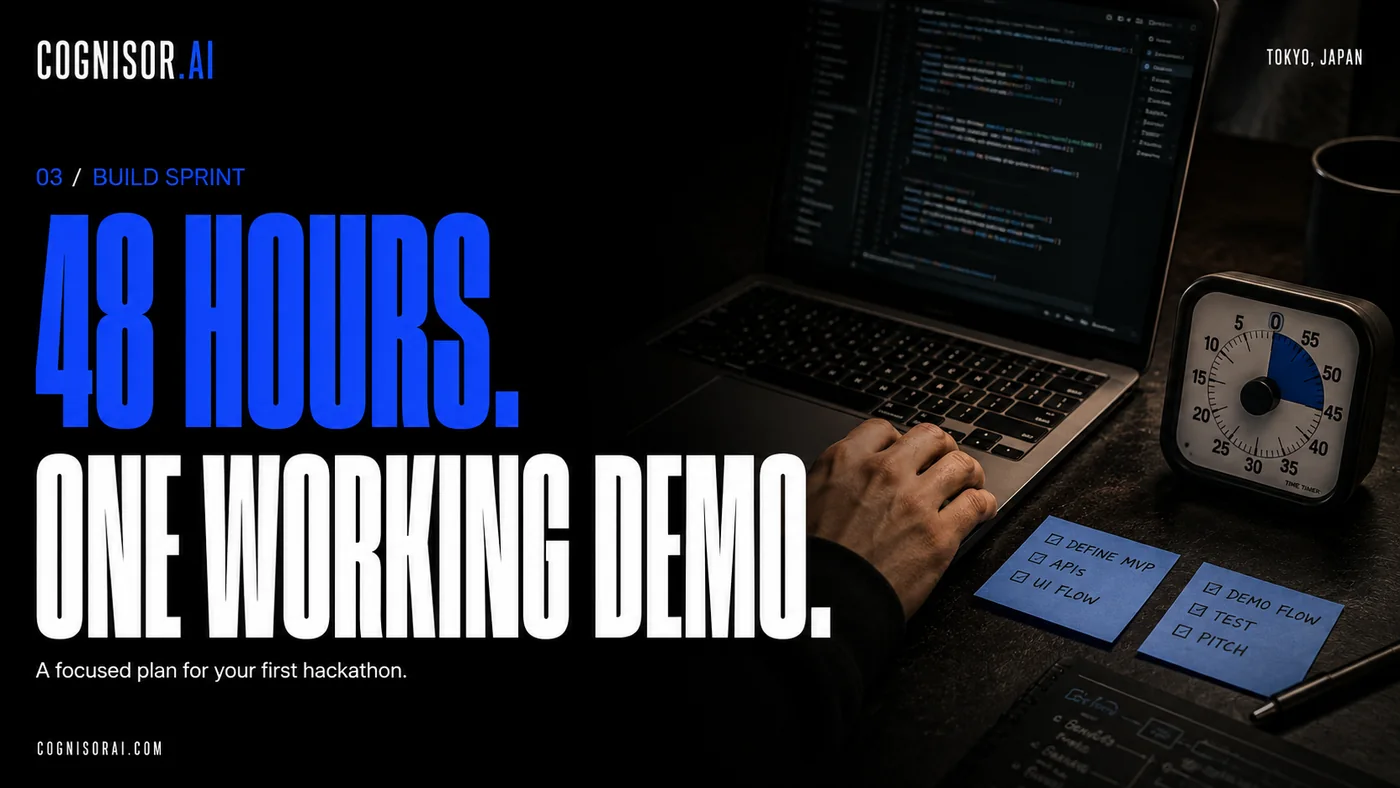
At a glance
- Build one complete user journey before extra features.
- Reserve time for testing and the final demonstration.
- Use realistic sample inputs and a transparent fallback.
On this page
Prepare before the event starts
Your first AI hackathon does not need an ambitious platform idea. It needs a team that can turn one small problem into a working demonstration. Before the event, check its rules, language expectations, and restrictions on preparation. Install permitted tools, confirm that your laptop can run the project, and understand how shared credentials will be handled.
The 48-hour schedule below is an illustrative plan. Adapt it to the organizer’s actual timetable and leave time for rest. A shorter event requires less scope, not the same workload squeezed into fewer hours.
If you are still choosing an event, use our Japan hackathon selection guide to compare the learning environment and participation requirements before committing.
Hours 0–4: agree on one promise
Describe the user and the task in a single sentence. For example: “A bilingual workshop organizer can turn an approved event brief into a Japanese and English attendee FAQ.” This is a hypothetical project idea. It has identifiable input, a visible output, and a person who can judge whether it helps.
Write three acceptance checks. The FAQ must preserve the event date, answer only from the brief, and clearly flag missing information. Decide which features are outside the demonstration. Payment, account management, and automatic publishing can wait.
Hours 4–16: complete the smallest working path
Divide responsibility by outcome: one person handles the interface, one handles the model connection, and one prepares examples and the story. A smaller team can combine these roles. Assign one person to integration so separately working pieces meet early.
First connect a sample input to a visible result, even if the initial response is a placeholder. Then replace the placeholder with the AI step. Keep API credentials on the server and out of the public repository. Use a small usage limit and watch the request count during repeated experiments.
Hours 16–28: test the awkward examples
Anthropic describes evaluations as tasks paired with a way to judge the result. Apply that basic idea with a short checklist your whole team understands. Include a normal input, an incomplete brief, a contradictory date, and a request outside your chosen scope.
For Japanese and English output, ask a suitable speaker to review names, dates, tone, and meaning. Do not judge a translation only by whether it looks fluent. Record which examples failed and what you changed. A small written evaluation is more useful than repeatedly refreshing until you get a good answer.
Hours 28–40: make the demonstration resilient
Add understandable loading, error, and empty states. Check the complete workflow on the machine you will present from. Prepare a clearly labeled recording or sample result in case connectivity fails; follow the event’s rules and explain when a fallback is being shown.
Ask someone outside the team to try the app without a spoken explanation. If they cannot find the first step, improve the screen before adding another feature. Use the remaining build time to fix the main journey and remove broken controls.
Hours 40–48: explain the product honestly
Structure the pitch around the user, the problem, a short demonstration, the evidence collected, and the next experiment. Show one meaningful limitation. Judges should be able to distinguish what currently works from what you hope to build later.
After the event, save the project notes and decide whether to continue. Our prototype-to-production checklist explains the next stage. For community opportunities, explore Cognisor AI hackathons and verify details on the current event page.